Giuseppe Tomasi di Lampedusa’s novel The Leopard opens in the final days of the Italian monarchy. A prince makes an empty pledge of allegiance to an impotent monarch, and imagines a well-trodden conversation with one of his royalist relatives:
Malvica would reply: “One particular sovereign may not be up to it, yet the idea of monarchy is still the same.”
That was true too; but kings who personify an idea should not, cannot, fall below a certain level for generations; if they do, my dear brother-in-law, the idea suffers too.
Malvica’s rhetoric may be familiar to readers of Julius Evola. But what of the prince’s response? What is to be done when the principle has failed to deliver for decades on end, and a generation has been raised knowing nothing but its failure?
Take the Zhou dynasty in ancient China. By 500 BC, the Zhou kings had grown so weak that they garnered no respect from their “client” kings. Eventually they were replaced. But the defenders of the principle continued against all odds to claim that Zhou was the rightful son of Heaven. Imagine how foolish this must have sounded! You who go around proclaiming on the Internet that democracies are illegitimate because they have no divine consecration, perhaps the medium of text consoles you: it makes your words look more logical and permanent, removes the emotional sounds of your voice. Can you imagine what it would take to go around walk through Washington, DC denouncing its disloyalty to the Crown? How about quitting your job and doing it for a living?
As the warlords continued their petty squabbles, seizing the common goods for themselves and depriving the people of their basic needs, more and more literate men saw no reason to get preachy about lost causes. They dropped out of the noble courts, changed their names, and became farmers in the fields, swapping aphorisms with each other such as “The name that can be named is not the true name.” In the courts, a bemused fatalism seemed to set in. It was an age about which someone might have indeed said that “the best lack all conviction, while the worst are full of passionate intensity.”
One day a Don Quixote appeared, wandering from kingdom to kingdom, offering to assist all the warlords in governing the state and performing the rituals correctly, but rebuking them, absurdly, for their disloyalty to the powerless Zhou. He never had stable employment and sometimes went days without food, but followers gathered around him. He possibly wrote down no words by himself, but in the generations after his death, books and sayings became attributed to him. He is remembered, for some reason, as China’s greatest hero.
A few centuries later, after the final destruction of the Zhou and decades of hardships and death, Confucius was finally given a biography for the first time. It was rough going for the biographer, Sima Qian, as he had no primary sources at all besides the Analects and some rather dubious sayings about Confucius by Mencius. But Sima Qian saw something brilliant in the Spring and Autumn Annals, which he believed to be full of Confucius’s own critiques of illegitimate seizures of power. He wrote of the book:
Its language is concise, its content profound. Though the rulers of Wu and Chu had styled themselves kings, the Spring and Autumn criticizes them by calling them barons. Although the duke of Qin actually summoned the king of Zhou to a meeting at Jiàntŭ, the Spring and Autumn records that ‘the Great King went to hunt at Héyáng’! These examples can be used as criteria in any age to criticize or condemn men’s actions, and later princes should uphold this tradition and broaden its applications. [after Yang and Yang 1979, p. 25]
In his biography of Sima Qian, Li Changzhi [1988:78] sees Sima Qian’s description of Confucius as a mirror for the historian’s own attitude towards the unfortunate subjects of his biographies.
It is as if Sima Qian’s spirit is coming forth from the page when he reads Confucius between the lines. He voluntarily adopts the words of Confucius, and weaponizes them, mastering their depth and breadth.
Sima Qian borrows all of his attitude towards injustice from Confucius. But Confucius had something in spades that Sima Qian cannot find anywhere he looks: hope. It was that boundless personal energy, faith in Tian and in the universe, that drove Confucius onward towards justice. Sima Qian had that faith and courage robbed from him. In his famous letter to Ren An, he bemoans his castration at the hands of an arbitrary emperor after he tried to speak out in defense of a good man. He proclaims that he will devote his life to completing his history, and speaks of the conviction that keeps people writing in devastating tone:
When Xibo, the Earl of the West, was imprisoned at Youli, he expanded the I Ching. Confucius was in distress when he made the Spring and Autumn Annals. Qu Yuan was banished and he composed his poem “Encountering Sorrow.” After Zuo Qiu lost his sight, he wrote the Conversations from the States. When Sun Tzu had his feet amputated in punishment, he set forth the Art of War. Lü Buwei was banished to Shu but his Spring and Autumn of Mr. Lü has been handed down through the ages. While Han Fei Zi was held prisoner in Qin he wrote “The Difficulties of Disputation” and “The Sorrow of Standing Alone.” Most of the three hundred poems of the Odes were written when the sages poured out their anger and dissatisfaction. All these men had a rankling in their hearts, for they were not able to accomplish what they wished. Those like Zuo Qiu, who was blind, or Sun Tzu, who had no feet, could never hold office, so they retired to compose books in order to set forth their thoughts and indignation, handing down their writings so they could show posterity who they were.
I too have ventured not to be modest but have entrusted myself to my useless writings. I have gathered up and brought together the old traditions of the world that were scattered and lost. I have examined events of the past and investigated the principles behind their success and failure, their rise and decay, in 130 chapters. I wished to examine into all that concerns heaven and humankind, to penetrate the changes of the past and present, putting forth my views as one school of interpretation. […] When I have truly completed this work, I will deposit it in the Famous Mountain archives. If it may be handed down to those who will appreciate it and penetrate to the villages and great cities, then though I should suffer a thousand mutilations, what regret would I have?
This must stand alongside the world’s greatest critiques of writing. Writing, says Sima Qian, is just an elaborate way to tell the world about your indignation. Writing is a therapeutic behavior which you must resort to because you have been wronged or defeated. These are the bitter words of a man whose romantic belief in standing up for goodness and justice was viscerally mutilated by reality.
Sima Qian confides to Ren An that “such matters as these may be discussed with a wise man, but it is difficult to explain them to ordinary people.” The life of the mind is defined by knowing other people write from a state of discontent, not only with local injustices, but with the human condition itself. Those who have never known such deep discontent make poor conversation partners. Conversely, those who have come to peace with the human condition have no need to defend their views in public. This is the meaning of the Tao Te Ching’s verse, “Those who know, do not speak. Those who speak, do not know.”
Confucius stood outside the corruption of society, harnessed the knowledge of the mean, and tilted at windmills totally secure in his ability to do good. Sima Qian stood outside the corruption of society and fell into despair. Like the Greek historians, Thucydides, Herodotus, Xenophon and Polybius, all of whom grumbled about how stupid their home cities were to exile them, Sima Qian writes with a glowing grudge. But unlike the Greeks, he recognizes that his grudge does not end with the people who punished him.
He called himself Tàishǐgōng, “the Grand Historian.” He gave his book the name Tàishǐgōng’s Documents, and he concludes every chapter with the statement, “Tàishǐgōng speaks.” But his official title was not Tàishǐgōng but Tàishǐlìng. The word “gōng” was a loanword from Chu: Li Changzhi writes that this was one of many aspects of Chu language, poetry, and customs that flourished at the highest levels of Han courtly life. [17-18] In effect, Sima Qian was emphasizing Chu’s cultural superiority to Han, and bemoaning its political loss.
Sima Qian is a man who has lost his manhood, his country, and his hope for goodness in the world. His grudge is against humanity itself, and he knows it: he never once tacks on a lying moral about how things could be better if a certain way of thought had been avoided, nor does he try to convince us that good men are rewarded and evildoers are punished. Li Changzhi writes:
Because Confucius knew not to put his trust in reality, did not waver in his claims, and sought an ideal within himself, he was able to achieve tranquility. That was not so for Sima Qian. With his inability to put trust in reality, he had to take up a stance of opposition to it. But even as he did so, unable to achieve tranquility, he tossed it out with indignation and lyricism. [89]
Why, and how, lyricism? Han was a somewhat pragmatic, realist nation. It stressed the importance of the “square and rule” and desired that its literary ideals be for practical effect. Chu, in contrast, was Impressionist. It was famous for his music. Its poet in the Songs of Chu described a grove of orange trees as “blues and yellows flowing into each other.” Sima Qian’s Chu was vanishing, and he himself was no mystic. He may have been a poet, but he ridiculed fiction and had an obsession for naturalistic facts. If he was going to preserve the memory of his vanishing country, it would not be through inventing stories about its heroism, but by manifesting the deepest and most beautiful principles of Chu into the style and method of his history.
So Sima Qian tells us of the founder of the Han, not as a hero or villain, but as an emotionally expressive man who loved his friends and his hometown. He tells us of the last dictator of Chu and how he sang a song to his horse as he fled alone to his last stand. He berates the emperor of his day as a superstitious fool, but also makes us empathize as the emperor searches endlessly for the supernatural in a disenchanted world. Nothing can escape his raw naturalism, but at the same time everything is illuminated in the pathos of a dying Chu romanticism.
Sima Qian does not write to plea with his readers to make the world different from what it is. Instead, he slyly suggests to the reader: History makes no promises that your pain in the service of the good will be rewarded, but those Quixotes who stuck to their principles through the “slings and arrows of outrageous fortune” became, in the end, our heroes. So too was he, in his personal commitments and in becoming a voice for his country and his people, a Quixote. I give the last word to him, through Burton Watson [after 1958:156]:
At the end of his biography of Fàn Jū and Cài Zé, he points out that luck and the right opportunities have a great deal to do with success. “But,” he concludes, “if these two men had not known suffering and hardship, how could they have risen to such heights?”
Bibliography
Li Changzhi, 1988 (original 1956). Sima Qian. Tokyo: Tokuma Bunko.
Tomasi di Lampedusa, Giuseppe, 1960 (original 1958). The Leopard. London: Collins.
Watson, Burton. 1958. Ssu-ma Chi’en: Grand Historian Of China. New York: Columbia University Press.
————— (tr.) 1961. Records of the Grand Historian of China. New York: Columbia University Press.
Yang Hsienyi and Gladys Yang (trs.) 1974. Selections from Records of the Historian. Hong Kong: Commercial Press.
Posted: January 27th, 2017 | Confucius
It’s now being widely reported in Western mass media that Japan is abolishing its social sciences and humanities departments. I am not actually annoyed by these reports, because in this instance the Japanese media have done no better. Here’s the Yomiuri Shinbun attempting to explain:
The Yomiuri Shimbun conducted a survey among the presidents of all 86 national universities across the nation to ask about their faculty reform and abolition plans as of the end of July, and how they reacted to the education ministry’s notice. The Yomiuri received responses from 81 universities.
Of the 60 universities with humanities and social science faculties, 58 responded to the survey and 26 said they had plans to abolish such faculties or convert them to other fields.
Of the 26 universities, 17 plan to stop recruiting students for these departments, which contain at least 1,300 students.
Many universities plan to abolish “no-certificate” courses that do not require students to obtain a teaching certificate in their teacher training faculty and allocate their existing quota to newly established faculties.
There’s a lot of stuff making this report confusing, so here’s a full rundown.
Read the rest of this entry »
Posted: September 23rd, 2015 | Academic mumbo jumbo
When I was last in Japan I wrote a series of blog posts on foreign reporting about this country. (1, 2, 3) At the time I was interested in the rather mundane matter of how individual reporters or their sources might spin a real problem and selectively exclude inconvenient facts. But after I left Japan in mid-2013, the problem of spin very abruptly ceased to matter.
I don’t really mean that it ceased to matter to me. Certainly, I’m still annoyed with one-sided reporting. But there is now a much larger problem at hand. The daily petty crimes against journalism on the streets of Öffentlichkeitburg have rather lost their relevance as the city is being actively destroyed by Godzilla. Or, to be really precise in my metaphor, a kind of katamari thing that keeps getting bigger and bigger and rolling everything else into itself. The poor people it sweeps up may try as hard as they can to put both feet on the ground, but it is no longer possible. They are not putting a spin on the world; they are the ones being spun.
With that rather ambitious prelude, I have a new Japan reporting story to tell. I don’t know how many of my readers have heard about the Japanese guy who spent over a year living entirely off contest winnings, so if you aren’t familiar, check out the story of Nasubi. This was an interesting story when I first read it around 2004, but 2014 has a very different take.
To be specific, he was made the subject of an episode of This American Life. Act One. I Am the Eggplant.
Read the rest of this entry »
Posted: September 8th, 2015 | Res pueriles
暑雨後坐月 Resting in moonlight after summer rain
黃任 huáng rèn (18th c.)
雨洗月逾潔 Pure she waxes, washed by rain.
氣寒光転幽 The air is cool, the light turns dim.
露蛍不自夜 Fireflies stave off the eve.
風樹欲先秋 Drafts in woods herald the fall.
烹茗籟遥起 Distant rushes cool my tea.
払琴泉暗流 Darkness falls as I strum my qín.
清宵不成夢 Brisk the night, and without dreams.
心跡両虚舟 Mind and deed, both empty boats.
Posted: June 20th, 2015 | Odes
Soumission
Michel Houellebecq
Flammarion, 2015 (English translation)
This book is about the life of a French academic who cares about almost nothing except the 19th century writer Joris-Karl Huysmans, but who discovers that the spark he inherits from Huysmans is snuffed out by the reality of 21st century France. Although he ends up converting to Islam, and despite Houellebecq’s grumbling about Islam in public interviews, this book is not an analysis of Islam at all, and people looking for one will be disappointed. It contains elements of a political manifesto, but attributing some viewpoint to Houellebecq would eliminate the psychological crux of the narrative. Islam is neither the disease killing France nor the magic potion to cure the narrator. Islam is simply a reality happening in France. Whether it becomes a comfortable or uncomfortable reality, a Self or an Other, is the decision of the milquetoast narrator and millions like him.
Tens of thousands of intelligent French people have converted to Islam (far more than in England). So why a novel, rather than a biography of René Guénon? This is a question that unappreciative reviewers who zip through the book finding nothing unusual about it need to ask. Why is the narrator so normal—and why is he so abnormal? He keeps on talking about Huysmans. “Well,” says the putatively leftist reviewer, “he’s a Huysmans specialist. That’s his job.” But what is a job? The narrator François is propelled around the country by Huysmans; he wants the religious conviction that Huymans had. It’s more than just a job for him. Who cares? Well, this question itself is the problem. Is Huysmans not of the West, and is the narrator not of the West, and are we not of the West? How is it that Huysmans became a moldy old “object of study,” and the narrator an alienated professor, and the reader segregated from both of them? How did this strange “normal” way of relating to literature arise, and where did our commonalities go? Houellebecq wants us to be confused by the narrator’s alienation, as much as the narrator is confused himself. He does not want to give us a sociological study about some object of research; he wants us to feel that we need to examine ourselves, that something has gone wrong.
François is free from some of the illusions of his generation. He recognizes the illusory nature of money. Money is a means to get what you want; but what he wants is the consolation and intimacy of books. He recognizes, too, the illusion of free love, and is bemused by how women seem to brush past him, guided by something unwritten (et d’autant plus puissant qu’il demeurait implicite) to drift from person to person without lasting bonds. Throughout Houellebecq’s novels, modern society encourages voracious sexual appetites, so that the sexless are forced to participate as well. François is more mundane than sexless, but one gets a feeling that he ought to be able to rise above shallow relationships.
But he is penned in by some strange limits imposed by “libertine” society. Despite his ability to appreciate Huysman’s intimate portraits of the inner lives of men and women, he finds that he is unable to articulate his own inner life in conversation (car les conversations sur la vie intime ne font pas partie des sujets considérés comme admissibles dans la société des hommes). Pre-modern literature, by giving him a taste of truth, has ruined his life, since he cannot share that truth with others; at the very least, his girlfriends do not care, and he cannot conceive of a willing audience. Thus François becomes a prototypical Houellebecqian protagonist, locked into a sinecure and unable to form close personal relationships; “un pauvre type”.
A solitary existence, living in a world that was nothing but him and Huysmans, gave him some respite for a time. But now he is thrust into a world he does not want any part of: the 21st century liberal arts academy, its disconnect from the meaning of literature, and its endless, circular obsession with what is strangely called “identity”. Immediately, without even bothering to describe the narrator’s politics, Houellebecq gives us three conflicting images: a discussion of a university president practicing identity politics (gender studies) and a Ph.D. candidate’s thesis on the “identitarian” movement, right in the shadow of the Grand Mosque of Paris.
What is an identity? To some, it is a political battle cry. François feels no such thrills. He can write about his literary passion, but his writing can neither change the world nor reveal his authentic frustration, as in some of Houellebecq’s prior novels. Identity politics is not his thing; but he cannot escape the ground shaking beneath his feet. His Jewish girlfriend suddenly leaves for Israel. Neither the “identitarians” nor the Muslims represent the France she believes in. But what is that France? One English review has already commented on François’ self-pitying words, “There is no Israel for me,” but I also liked his girlfriend’s confused attempt to find a heritage she can claim: “J’aime la France! … J’aime, je sais pas… j’aime le fromage!” There is not only no Israel for François to flee to, there is no France for him either. There is only the after-image of Huysmans, transposed onto an unrecognizable cultural wasteland, where “identitarians” prowl after scraps.
To be fair, Houellebecq does not imagine the collapse of civilization. He imagines a peaceful Socialist-Muslim joint government that models itself after Chestertonian Distributism. This is, perhaps, a rather optimistic ideal of what the world like look like in 2022. The new, forward-looking government has solved many social problems by including Muslims in its governing alliance, and it feels like a sorte d’empire romain reconstitué. But as Oswald Spengler said, the Roman Empire only arose when the Republic had been defeated. They may cheer on the name of Chesterton, but the true king of France in 2022 is Spengler, constantly whispering his memento mori into the ear of the newly crowned Caesar (sorry for the mental image). At last the deus ex machina, a guy named Rediger, appears, accompanied by his nubile young wife Aisha, to convert the narrator to Islam; Rediger speaks precisely to François’s insecurities and worries, and proposes that, just like in Histoire d’O, Islam makes it possible for women to submit to men, and human beings to God.
Houellebecq is not actually arguing that this is the natural order of the world. In fact, by placing this argument into the context of François’s hedonism, he immediately problematizes it. The Histoire d’O-citing convert Islam that Houellebecq imagines in a half-sardonic, half-nihilistic tone clearly does not escape his criticism. It is not a French Islam, but an anti-French anti-Islam, based on a muddled confusion of both Middle Eastern and Western European traditions. But what is François supposed to do? No Christian or atheist has been able to offer him any hope. Only the East offers the faint glimmering of a road he can walk. Perhaps if he walks it long enough, his lie will begin to seem like truth.
The correct response to the end of the book is not despair, or excitement, but pathos. But those who skim the book looking for political arguments to use in their own little battles will naturally not only miss the point, but in fact do damage to whatever remaining value literature has to the Western European tradition. It is the darkest of ironies. Houellebecq’s character François loses faith in Huysmans, because he cannot hope to bring Huysmans to people around him. He burns his past; Islam is his only remaining path. Houellebecq writes a book about this, and the clickbait reviewers of the decayed “public sphere” deny him the ability to really connect with his readers, even as he lives. It is no wonder that Houellebecq has declared himself exasperated with having to promote his book, and as of this week has canceled all future interviews about it. But what of Europe?
Posted: May 26th, 2015 | Book Reviews
The first poem of the Book of Odes 詩経, translated by Ezra Pound. Pound originally wanted the Chinese to be included alongside his translation, but his publisher at the time didn’t care and this has never been done before this blog post. Pound also wanted a phonetic transliteration, but this is a lot of work because of the changes to Chinese over the centuries. I here include a rather butchered version of Pan Wuyun’s reconstructed phonology. You can compare with other translations on Matt’s blog.
關關雎鳩,
在河之洲。
窈窕淑女,
君子好逑。
|
Kroon kroon skha ku,
zuu’ gaal kju tju.
Quuw’ g-leew’ gljiwg na’,
klunsy’ hmhuu’ gu.
|
“Hid! Hid!” the fish-hawk saith,
by isle in Ho the fish-hawk saith:
“Dark and clear,
Dark and clear,
So shall be the prince’s fere.”
|
參差荇菜,
左右流之。
窈窕淑女,
寤寐求之。
|
Shuum skhraal graang’ shuus,
saal’ ghwu’ ru kju.
Quuw’ g-leew’ gljiwg na’,
ngaas mids gu kju.
|
Clear as the stream her modesty;
As neath dark boughs her secrecy,
reed against reed
tall on slight
as the stream moves left and right,
dark and clear,
dark and clear.
|
求之不得,
寤寐思服。
悠哉悠哉,
輾轉反側。
|
Gu kju pu tuug,
ngaas mids snu bug.
Luw stuu luw stuu,
ndens ton’ pan’ skrug.
|
To seek and not to find
as a dream in his mind,
think how her robe should be,
distantly, to toss and turn,
to toss and turn.
|
參差荇菜,
左右采之。
窈窕淑女,
琴瑟友之。
參差荇菜,
左右芼之。
窈窕淑女,
鐘鼓樂之。
|
Shuum skhraal graang’ shuus,
saal’ ghwu’ shuu’ kju.
Quuw’ g-leew’ gljiwg na’,
Grum sbrig ghwu’ kju.
Shuum skhraal graang’ shuus,
saal’ ghwu’ maaw kju.
Quuw’ g-leew’ gljiwg na’,
tjong khwaa’ nggraawgs kju.
|
High reed caught in ts’ai grass
so deep her secrecy;
lute sound in lute is caught,
touching, passing, left and right.
Bang the gong of her delight.
|
This is possibly the best translation ever made from the Book of Odes. It is far more wild than literal, but it has uncanny accuracy. A prince (klunsy’, Japanese kunshi) is to marry a “modest, retiring, virtuous, young lady,” as James Legge literally puts it. The word “lady” is straightforward, which is why Pound sought out “fere” instead. The two words describing her, quuw’ g-leew’ 窈窕, are less so. They are both written with the radical for “hole”, which is rarely seen in Japanese these days outside of the word 穴 “hole” itself and 空 “sky”. (Not actually true, thanks Leoboiko.) 窈 literally means “deep”, perhaps with a connotation of “concealed,” and 窕 means some sense of “refined”. Pound finds two wonderful yin-words to express the passiveness of the lady: “dark and clear.” While one may wonder where the second definition came from, the phrase 窈窕 was used much later by Tao Yuanming to refer to a mountain stream, so I think Pound has it spot on. He knows this so well that he repeats it twice.
In the second verse a lot of compromises are made. The word “stream” comes up twice where the text speaks only of flowing, “modesty” and “dark boughs” come lurching out of nowhere, and waterlilies become “reeds”. But this framework allows some of the repetition of the original to come through without sounding cloying to the modern ear. Finally the phrase “dark and clear” comes up again twice. The literal text is again referring to the lady, but in the next line it is made apparent that she is not yet meeting with anyone, but we are only hearing of the man being consumed with thoughts of her, both in waking and in dreaming. Pound uses the fuzzy impression of color and water, offering a dreamlike state, before translating the specific image of dreaming in the following verse.
In the third verse the word “distantly,” included in the ancient Chinese sense of 思, is worked in nicely. The translation falters a bit after this, though. The addition of the word “robe” does not really fit the poem; even this would have been a little too physical in ancient China. And there is no sense that the “reeds” are being gathered and picked by human hands, in preparation for a wedding celebration. Instead, the plants continue to bump around until the end of the poem. Still, it ends with a satisfying bang.
Posted: April 18th, 2015 | Odes
Earlier in this blog we heard from Nishibe Susumu and Watanabe Shōichi. Now it is time to break out the list of the man himself, Kure Tomofusa, from his book New Techniques for Readers 読書家の新技術 (1987). Kure-sensei sorted his recommendations into categories.
Politics
Carl Schmitt, The Concept of the Political
Carl Schmitt, Political Theology
Carl Schmitt, Theory of the Partisan
Yoshimoto Takaaki, Tentative Proposals on Mathieu (A recommendation offered without comment in New Techniques, but in 2012 Kure-sensei reread Yoshimoto’s complete works and discovered that he had been deceived by the difficult style of writing, and in fact there was nothing interesting about them. I’m guessing he would rescind his recommendation.)
D. H. Lawrence, Apocalypse and the Writings on Revelation (Recommended as a supplement to reading the Bible.)
Carl Schmitt, Essays on Political Philosophy
Engels, The Origin of the Family, Private Property and the State
Lenin, State and Revolution
Yoshimoto Takaaki, Communal Illusions (Read instead Kure-sensei’s commentary on this book.)
The rest of the suggestions are not nearly as interesting… Read the rest of this entry »
Posted: March 15th, 2015 | Books
Just want to wind things down with a proper conclusion. The Kogakkan study program is a truly excellent one featuring top quality classes on Shinto and a lot of hands-on experiences. The teachers are really friendly and open to further discussion, and my supervisor Tamada-san as well as the other supervisors and volunteers were wonderful people who I hope to keep in touch with in the future. I’d recommend the program to anyone stumbling across this blog.
Here’s my summary essay (more like a summary blurb…), which is based on a presentation I gave to the school president and many other dignitaries.
I think it is important to understand the uniqueness of what foreign students learn on the Ise and Japan Study Program. In particular, I would like to say a word about the lectures and tours offered to us by Shintogaku professors. Shintogaku is an approach to thinking about spiritual culture that exists only in Japan. The primary purpose of Shintogaku is to train students to become shrine priests. But Shintogaku professors, through writing books about shrines and educating the general public, also create a common standard for practices at shrines across the country. When Japanese people go to shrines, they know what to expect. In this way, even as shrines are non-sectarian and welcome freedom of belief, they can continue to maintain their traditions for future generations.
When foreigners want to read about Shinto, it is very rare for them to run into Shintogaku. It is far more common to encounter the personal opinions of priests, new religious leaders, or foreigners who have been to Japan. Even the authors of textbooks about world religions can be led astray by these opinions. Japanese people may be surprised by what foreigners read about Shinto in English. My experience on this program, and during my other trips to Japan, has shown that true quality in talking about Shinto is best obtained by reading, talking, and thinking about why shrines exist in the way that they do.
From the Kogakkan professors who participated on this study program, I learned that Shinto has a very deep and complex history. Shinto has a unique perspective on how to preserve traditions and spiritual culture. Religious studies and theology are ill equipped to confront the types of discussion that take place within Jinja Honcho. In the 21st century, culture clashes, based on misunderstanding of the culture of other countries, are resurfacing and are already the cause of serious international conflicts. This is an important time for foreigners interested in Japan to collaborate with Japanese Shintogaku professors in order for the world to gain a new and enlightening perspective on human diversity.
Posted: March 15th, 2015 | Kogakkan
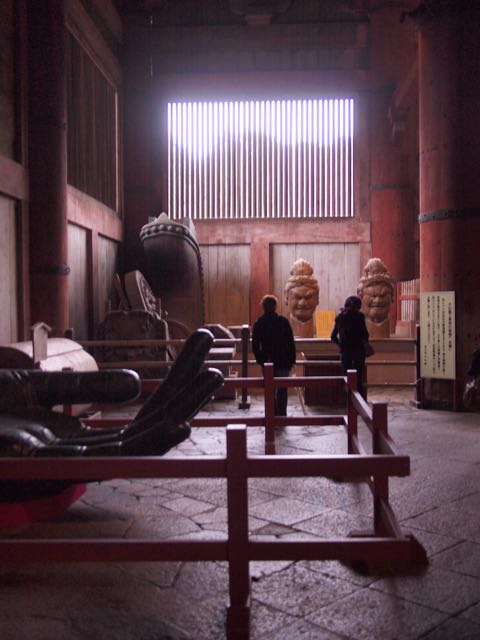
The past few days days have given us a little more free time, but actually the pace has been picking up as we begin work on our final presentations for Thursday. (I haven’t yet started work on mine.) Over the weekend we were given a free tour of Nara and Kyoto. I like this photo I took inside the hall of the Great Buddha.
I can only offer a few thoughts about the outing to the mature port town of Oominato we had yesterday. The people of Oominato were overjoyed to have foreigners visiting, and everyone stepped out of their homes and were watching us as we walked down the street surveying the town. They used to build ships here, but it seems that people do not order so many ships anymore. There is a very beautiful-looking, 120-year-old ryokan in this town, a relic of a time when people would arrive on boats on their way to the Jingu. The ryokan seems to be completely empty now, which makes me sad because it’s kept in great condition and is very clean. Here are some pictures. Consider it for your visit to Ise!
Today we all enjoyed a tea ceremony. I got to go inside a tea house used in the full-formal ceremony, and inside I felt like I should be acting a lot more formally. You get the instinct that you need to know where to move for each step of the ritual. We then went into a half-formal room and had tea served to all of us, but the servers really did know what they were doing the whole time, and it was quite impressive.
We all tried to whisk the tea ourselves, but no one seemed able to accomplish it in the same way the servers had done it. I tried to take some pictures but they came out blurry. Agh
Time to get working on my final presentation!
Posted: March 10th, 2015 | Kogakkan
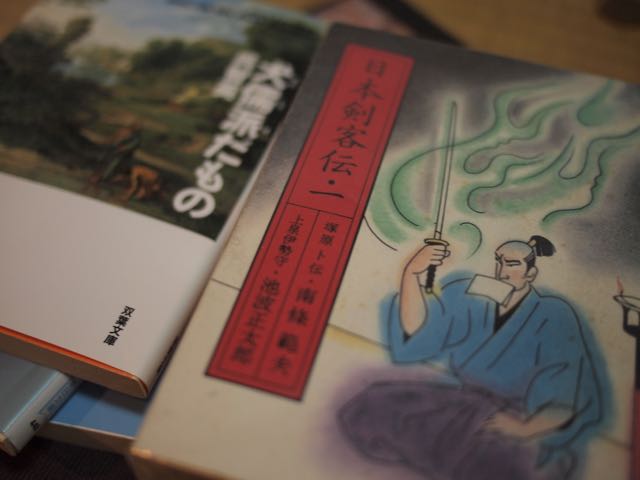
After the lectures today we went to an old-fashioned used bookstore full of extremely good-quality works of history, literary criticism, and philosophy. Micchan bought the Heike monogatari, Michael bought a full set of Biographies of Japanese Swordsmen, and I found some nice books by Kure Tomofusa. The owner did not charge me full price for them, even though they were only priced at 400 yen each. I reflected on this a lot as we walked back to the dormitory, and I believe that the only reason he could have done this is because he didn’t care about the price at all, but was simply happy to see so many foreigners interested in Japanese literature. This is a type of interaction that I will never have over Amazon.
Without further ado, here are summaries of the three lectures!
Shimizu Kiyoshi
The gist of President Shimizu’s talk was that the Saiō symbolically brought the miyabi, or urban beauty, of the imperial capital to Ise. For a summary of his main point I will forward readers to Paula’s blog. I was much more interested in three tangents he went on:
(1) Why is the shikinen sengū necessary? He asked us to supply answers, and I gave him the standard answer that it’s because the kami like new, well-maintained buildings better than old buildings. He agreed, but then looked very expectantly to the room for another answer. He must have really expected more creativity from us! He then offered to us the possibility that the shikinen sengū teaches us a constant lesson about maintaining our mastery of difficult arts. The shikinen sengū creates something that is “newly old” (新しく古い). It therefore is a constant renewal and “revival” (甦り) of tradition. These days, the traditional crafts involved are so hard to come by that the implements for the shikinen sengū are often produced by “living national treasures”. But the renewal is about more than just the technology involved. The entire ritual must be constantly in the memory of the shrine priests, and the memory must be turned into action on a regular basis, once every 20 years.
(2) When Japan’s era name or nengō system was first introduced, said Professor Shimizu, they changed the name of the era whenever a good omen occurred, such as a great harvest or the appearance of a beautiful cloud. But by the later Heian period, the era was only changed when there was a bad omen, in order to ward off evil. The character of a nation changes with the times. Over the centuries, the Heian court became lax in its observation of the omens, and fell into depravity. Just like ancient Rome, the Heian aristocrats enjoyed endless parties as their political system began to decay around them. The Genji monogatari is a kind of high-water mark in the development of the classical court; a book that could not have been written in the Asuka or Nara periods, but which foreshadowed a decline.
(3) Ise is not the only religious institution in Japan that has been operated continuously since Asuka times. The Tōdaiji temple in Nara was built in in the early 8th century and has held a ceremony called shunie 修二会 nearly every year since 752. This year will mark the 1264th annual ceremony, which involves a traditional combination of Buddhist and Shinto rituals.
Sako Kazukiyo
Yamada Yoshio has been dubbed “the last national scholar,” but I believe we heard today from the last prewar scholar, Kogakkan’s director Sako Kazukiyo 佐古一洌. Unlike most of the other professors who spoke to us, Sako-sensei had no PowerPoint. Actually, his entire talk was a series of handwritten notes, and it quickly became evident he had never used a computer. He spoke in the highly educated and chauvinistic style of a prewar professor, which I found remarkably endearing, but also almost completely incomprehensible.
In place of an introduction, Sako-sensei shared with us some remarks about being old; he is 74, and as there are over 50,000 centenarians in Japan, he expects to live a bit longer. They are mostly women, though, so he amended this to say maybe he wouldn’t live that long. He said there was a method to beating senility named after the powers of 10. One must do the following every day: read one book, laugh 10 times, stretch 100 times, write 1000 characters (i.e. a letter to a friend), and walk 10,000 steps (一読、十笑、百吸、千字、万歩). To be honest this sounds like a great plan not just for old people but for people of every age.
Sako-sensei’s talk revolved around two points: (1) the Japanese spirit of magokoro, which I have written about in connection with the Genji monogatari, and (2) the Japanese tradition of matsuri, festivals. Matsuri is the expression of magokoro, and this is all that ever needs to happen in Japan. Unlike President Shimizu, Director Sako lives in a glorious, timeless state where the Japanese spirit and festivals are not subject to weathering and decay, but have simply always existed, and always will. He saw on television once that there are over 300,000 matsuri celebrated in Japan every year; therefore there are hundreds of matsuri taking place somewhere in the country every day. Contemplating this is clearly a great delight for him. He offered some words in praise of Minakata Kumagusu, who tried to stop the consolidation of shrines and save local chinjū-no-mori ecosystems back in the Meiji period.
The origin of these hundreds of thousands of matsuri was in desire for health, long life, marriage, safe childbirth, and worldly success. These are all expressed through magokoro, an honest heart. (Although he criticized the Chinese for encouraging selfish behavior in their philosophy, Sako-sensei’s definition of magokoro is rather Neo-Confucian, as I pointed out in my Genji paper.) Because women more often pray for the success of others, they have more pure hearts than balding old fools like Sako himself; this information came to him via his daughter. But regardless, Amaterasu commanded Lord Jimmu to create a country of people with pure and honest hearts, so it is the duty of every Japanese to avoid la négativité. In this one-hour talk, I am fairly certain that the only loan-word Sako-sensei employed was this one word “negatiibu“. The only thing he wrote on the board was the related phrase 神州清潔の民, “pure people of the divine country”.
Modernity was just a bothersome bit of foolishness to Sako-sensei, who whipped out a bit of English skills to quote Lincoln’s phrase “government of the people, by the people, for the people,” then replaced the Japanese word for “people,” jinmin 人民, with what he called its Edo period equivalent, ugō-no-shu 烏合の衆, making democracy the “government of the rabble, by the rabble, for the rabble.” The people of the Edo period had a better goal in mind: self-sufficiency, 自給自足. They were able to produce for themselves (自給), and they felt satisfied with what they had (自足). The complex world of democratic politics and technology is a mere distraction from the essentials of magokoro and matsuri.
Sako-sensei had saved the real tear-jerker for the end of his speech: a soaring anecdote about the end of the Pacific War. He was apparently completely unconcerned by the fact that the grandparents of his audience would have been fighting on the opposite side in that war; but in the end this didn’t matter anyway, because I am convinced that, since our Japanese friends were not listening to this talk, no one in the room understood a word he was saying at this point. The majority of his anecdote was a direct quotation of the way people spoke in 1945, which is basically Greek. So if my classmates are reading this and think I must be some kind of genius to have written down the whole anecdote, please rest assured that all I did was write down some misspelled names and dates and found the text he was quoting on the Internet.
On August 14, 1945, past 11 PM, after the Cabinet meeting on ending the war had adjourned, I [Hisatsune Sakomizu] entered the Prime Minister [antiwar navy admiral Suzuki Kantarō]’s office, and offered my thanks to him for taking on the challenges of that day.
We sat facing each other, and it naturally it was impossible to avoid crying. The Prime Minister sat across from me in pensive silence.
Unexpectedly, we heard a knock at the door. We turned to see Army Minister Anami [Korechika] enter with his sword equipped and his hat at his side. I stood and observed from the side.
The Army Minister walked directly to the Prime Minister’s desk and bowed respectfully.
“I said many things at today’s cabinet meeting, and I fear I must have caused some offense. I wish to humbly offer my apologies. My sole desire is for the protection of the national polity; I have no private motive. I beg your understanding of this.”
Seeing tears falling from Army Minister Anami’s face, I also began to cry. Then the Prime Minister, nodding in assent, rose to meet Army Minister Anami and said,
“I understand your intention, but Anami, the royal house will remain secure. No matter what happens, His Majesty will continue to personally and thoughtfully make offerings to the imperial ancestors every spring and autumn.”
Army Minister Anami said, “This I too believe.” He bowed deeply and departed.
After I saw him off at the door, the Prime Minister said, “Korechika came to say goodbye.”
I shall never forget that sight, as long as I shall live.
Anami Korechika committed seppuku later that night. But he died knowing that the matsuri would go on.
Kamo Masanori
Our last lecture of the day was from Kamo Masanori 加茂正典. He gave us the surprising news that the Saiō system was not the only link between the classical court and Ise. This was actually kind of comforting in a way, because I was wondering who actually was allowed inside Ise between 1300 and 1700. The Saiō didn’t come anymore, and the Emperor never visited… were the shrine priests and miko very lonely in there?
In fact there was another imperial messenger, called the Shiō 使王, who appeared even in the Nihon Shoki. Kamo-sensei seemed to have a poor sense of time and spent most of the hour explaining the divination system by which the Shiō was selected in the classical period. We heard that his main duty was to make offerings of silk and thread, but we did not get to hear about the rest of his job.
Unlike the Saiō system, the Shiō system continued throughout the Warring States and Edo periods, making it a hallmark 1150-year tradition that ended in… YUP, THAT’S RIGHT, 1871.
Posted: March 6th, 2015 | Kogakkan