Some interesting excerpts from Yasaka Takagi, ed., The Late Dr. Inazo Nitobe’s Unfinished Translation of Lao-Tzu and the Kojiki (Tokyo: Institute for Comparative Studies of Culture, 1963). The Lao-Tzu translation is not very remarkable except for a surprising cross-reference between ch. 28’s comments on “masculinity and femininity” and chs. 21 and 22 of a book called The Secret of Swedenborg by one Henry James.
As for the Kojiki text, it was written circa 1925-6 while Dr. Nitobe was a diplomat at the League of Nations, and is therefore the second English translation of the Kojiki, after the Orientalist effort of Mr. Chamberlain. I believe it is also the third translation ever, after the estimable work of Karl Florenz in 1919. It consists mostly of brisk summaries in sometimes oblique, sometimes welcoming English.
pp. 121-2
A summary of Japanese theories, showing the extent to which the Kojiki was considered a grounds for historical research in the prewar period:
Is this place [Takamanohara –AHM] wholly mythological so that there is no locality on earth to correspond to it? — If, on the contrary, it is a geographical location, where is it? Many conjectures have been advanced as an answer. (1) Somewhere in Central Asia, perhaps at the foot of the Altaian range, whence our race, at least philologically, seems to have come. (2) South Sea Islands. (3) Korea. (4) Japan itself,–in this case, in the South according to one theory; in the middle says another. (5) Armenia. (6) Hittite Kingdom. (7) Are we descended from Sumerians?
p. 127
As above:
The probable date of Susano-wo is given by Prof. Kume as 180-156 B.C.
pp. 135-6
A representative example of the style of writing:
Illuminatrice despatches Great Ears (Osiho-mimi) [Amano-Oshihomi] to the Plain of Abundant Reeds; but seeing that the land is in trouble, he returns to heaven and High Conjoiner and Illuminatrice convoke to a meeting eight hundred myriad Kamis for deliberation and with their counsel and the advice of Thinker, they decide to send down Hohi, a son born of Illuminatrice by Rashling; but he, on coming to the Plain, fawns to Land-Lord and stays with him for three years. For the third time, High Conjoiner and Illuminatrice confer with kamis, and send Young Prince (Wakahiko); but on coming to the Plain, he weds Land-Lord’s daughter and stops for eight years. A general assembly is held again and it is decided that this time a nameless female pheasant should be despatched. The bird alights on a tree near Young Prince’s gate, and delivers the message to him, but a spying woman insists upon Young Prince to shoot the pheasant through in the bosom.
p. 149
A note to the reign of emperor Sujin:
The erection of numerous shrines throughout the country means perhaps not that they were newly built where nothing had existed before, but that the “earthly” (native or local) objects of worship were acknowledged or adopted by the reigning house. One may consider it as an absorption of a native religion by the ruling family or a religious assimilation of the conquering and the conquered races.
p. 154
A nice turn in translation:
The Emperor having heard of the beauty of certain two sisters in Mino, despatched Oh-wusu, one of his elder sons to summon them to the court; but Oh-wusu, on reaching their home, took them for himself and sent two other women under the name of the sisters. When they arrived, the Emperor knew they were not the right ones, never married them but only subjected them to long glances so that they felt exceedingly embarrassed.
Posted: August 27th, 2014 | Excerpts
“Why everyone should fear deceit, Part 5” 詐怖縁第五 from 諸經要集 (T2123, 0149b29), a non-canon collection of Buddhist admonitions and anecdotes from the Tang dynasty.
I translated this without punctuation because it’s funnier that way.
It is written in the Mahāprajñāpāramitā Sutra: all composite things, every one is deceit. Sentient beings are foolish, unaware of close and distant. Hate, harsh speech, harm, up to taking a life. It creates these great crimes. So falling into three hells, we create innumerable sufferings. For example, in the mountains there was a little stupa. In the stupa there was a monks’ quarters. In the quarters was an oni. It brought fear and vexed the monks. There were many monks, all abandoned monks’ quarters. A traveling monk came. Rector showed him to empty quarters. And said these words. Within these quarters is an oni, spirits rejoice, vexing men. If you can live within here, go ahead! The guest monk himself had become very strong by observing precepts. Said: Little oni, what of it? I can subdue him. Saying so, he entered the monks’ quarters. Another visitor monk came seeking an abode. Rector also sent him to the monks’ quarters. Again said there is an oni men fear. This man again said, Little oni, what of it? I should subdue him. The first monk had closed door and wait for oni. At nighttime the second monk hit door, seek to enter. The first monk said, here is the oni! Not allow open door. The one who came later hit door quite strong. The monk within using strength prevented this. The one outside succeeded to enter door. The first monk hit the second, the second hit the first. At last dawn came. Really they were old fellow students. Already knew each other; they bowed in shame. Many people gathered around laughing, what strange ones! All beings are like this. Five skandhas are all void. No self, no person. Arguing over external forms creates poison and harms. Free yourself from earthly things. We are only bones and meat. No person, no self. Therefore, bodhisattvas say to all beings. You will not reach heavens by arguing. Human body desires unobtainable. How much more so for Buddha.
Read the rest of this entry »
Posted: November 20th, 2013 | Excerpts
The 666th discourse in Reikai Monogatari is entitled “666”. However, this 666 is pronounced “Miroku”, the Japanese word for Maitreya, the future Buddha who will unite mankind. In Japanese, 3 is “mi” and 6 is “roku”, so “Miroku” = “three sixes” = 666. I have decided some parts of this bizarre chapter are worth translating.
Read the rest of this entry »
Posted: April 5th, 2013 | World Peace
I decided that the most important thing my blog could do for anyone would be to convey these quotes to people. Simply by copying and pasting them I feel that I have accomplished something.
Let’s start with my favorite thing anyone has ever said about the world we live in today. G.K. Chesterton said it.
If we all floated in the air like bubbles, free to drift anywhere at any instant, the practical result would be that no one would have the courage to begin a conversation. It would be so embarrassing to start a sentence in a friendly whisper, and then have to shout the last half of it because the other party was floating away into the free and formless ether. The two must hold each other to do justice to each other. If Americans can be divorced for “incompatibility of temper” I cannot conceive why they are not all divorced. I have known many happy marriages, but never a compatible one. The whole aim of marriage is to fight through and survive the instant when incompatibility becomes unquestionable. For a man and a woman, as such, are incompatible.
Now, onto Heretics:
If we were to-morrow morning snowed up in the street in which we live, we should step suddenly into a much larger and much wilder world than we have ever known. And it is the whole effort of the typically modern person to escape from the street in which he lives. First he invents modern hygiene and goes to Margate. Then he invents modern culture and goes to Florence. Then he invents modern imperialism and goes to Timbuctoo. He goes to the fantastic borders of the earth. He pretends to shoot tigers. He almost rides on a camel. And in all this he is still essentially fleeing from the street in which he was born; and of this flight he is always ready with his own explanation. He says he is fleeing from his street because it is dull; he is lying. He is really fleeing from his street because it is a great deal too exciting. It is exciting because it is exacting; it is exacting because it is alive.
The human race, according to religion, fell once, and in falling gained knowledge of good and of evil. Now we have fallen a second time, and only the knowledge of evil remains to us.
Every one of the popular modern phrases and ideals is a dodge in order to shirk the problem of what is good. We are fond of talking about “liberty”; that, as we talk of it, is a dodge to avoid discussing what is good. We are fond of talking about “progress”; that is a dodge to avoid discussing what is good. We are fond of talking about “education”; that is a dodge to avoid discussing what is good. The modern man says, “Let us leave all these arbitrary standards and embrace liberty.” This is, logically rendered, “Let us not decide what is good, but let it be considered good not to decide it.” He says, “Away with your old moral formulae; I am for progress.” This, logically stated, means, “Let us not settle what is good; but let us settle whether we are getting more of it.” He says, “Neither in religion nor morality, my friend, lie the hopes of the race, but in education.” This, clearly expressed, means, “We cannot decide what is good, but let us give it to our children.”
“Democracy is the worst form of Government except for all those other forms that have been tried from time to time.” Winston Churchill
Finally, Orthodoxy:
The madman’s explanation of a thing is always complete, and often in a purely rational sense satisfactory. Or, to speak more strictly, the insane explanation, if not conclusive, is at least unanswerable; this may be observed specially in the two or three commonest kinds of madness. If a man says (for instance) that men have a conspiracy against him, you cannot dispute it except by saying that all the men deny that they are conspirators; which is exactly what conspirators would do. His explanation covers the facts as much as yours. Or if a man says that he is the rightful King of England, it is no complete answer to say that the existing authorities call him mad; for if he were King of England that might be the wisest thing for the existing authorities to do. Or if a man says that he is Jesus Christ, it is no answer to tell him that the world denies his divinity; for the world denied Christ’s.
Oddities only strike ordinary people. Oddities do not strike odd people. This is why ordinary people have a much more exciting time; while odd people are always complaining of the dulness of life.
The old fairy tale makes the hero a normal human boy; it is his adventures that are startling; they startle him because he is normal. But in the modern psychological novel the hero is abnormal; the centre is not central.
There’s a lot more from this last book that I’m currently chewing on.
Posted: April 22nd, 2012 | Excerpts
Every day, Longreads and Longform post long, well-researched articles. But sometimes people write whole books and just post them to the Web, which apparently are too long even for these sites. Here are some great non-fiction, fascinating e-books that are free to download.
The Great Internet Conspiracy: The Role of Technology and Social Media in the 9/11 Truth Movement
The Boy Who Cried Wolf is, in modern parlance, a simple “troll.” He delights in posting inflammatory material in public spaces to cause unnecessary concern, and he then laughs at the angry reactions he provokes. In the fable, he only gets away with this once before his village brands him as a troublesome nut. The rest quickly ignore him, leaving him to experience poetic justice in short order. But on the Internet, this could not happen.
With social media at his fingertips, the Boy’s alarm message would spread well beyond his village. Some people would find his initial posting at once, while others would find it much later. A few would accidentally revive it years after the fact. But to pick a time at random, say one week after he had his fun, both the initial “fake” alert and the later “real” warning would be available simultaneously, with no way to predict which would be more widespread and more likely to come up on a search engine. Both would also be mixed in with a bewildering array of angry posts, some by people who had been duped, others noting that he was actually right.
The Broken Buddha: Critical Reflections on Theravada and a Plea for a New Buddhism (Some knowledge of Theravada Buddhism is a must.)
A man I know attended a Thai temple in Singapore for fifteen years before becoming one of my students. He could chant the five Precepts but couldn’t name any of them and didn’t know that what he was chanting referred to morality. He did know however, that every time he went to the temple that he should give an hung pow (monetary donation) to the monks. Young well-educated Asians have often told me that they got their first real understanding of Dhamma when they joined a Buddhist group at the university where they were studying in the West…
The Esperanto Book
Esperanto is sometimes criticized for using compound words where a “real” or “natural” language would have a “real” word. What constitutes a “real” word, as distinct from a compound word, turns out not always to be apparent to such critics. One Esperantist reported the case of a woman who, informed of the use of mal- to create antonyms, cried out in dismay: “You mean Esperanto has no basic word for unhappy?”
Posted: February 13th, 2012 | Books, Dharma
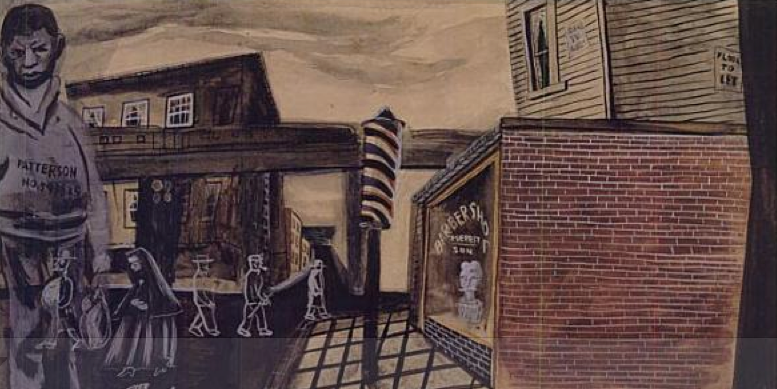
Reading Whittaker Chambers’ Witness for the first time, I was intrigued by his mention of an innocent Japanese college student swept up by the Communist underground in America. Hideo Noda (野田英夫, 1908-1939), nephew of the peace-loving socialist politician Prince Fumimaro Konoye and student of Diego Rivera, was a warm-hearted and talented man apparently drawn to Communism by a genuine sympathy with the poor. You can see in his 1933 work Scottsboro Boys (pictured) a portrayal of working-class urban life that should be familiar to any visitor to an American city. After a discussion with Chambers, Noda eagerly agreed “to go to Japan to work as a Soviet underground agent”, although Chambers does not make it clear if Noda realized that this work would involve espionage.
At this point I decided to Google Noda’s name, and found both an unrelated Japanese-American nisei painter with the same name (crazy coincidence!), and an English biography on the website of a museum which carries his work. This biography is curiously whitewashed of his Communist adventures, although according to Chambers, they occupied a great part of his life after 1934.
Here is how the museum describes his later life:
Noda didn’t adhere to authority or strive after a false reputation. He was a humantistic [sic] painter who turned his eyes to the world of the mind and continued painting the working class, immigrants, circus performers, the unemployed and children from the bottom strata of society. In 1938 he was diagnosed with a brain tumor but continued to paint, holding his eyelids open with adhesive tape. Noda died prematurely at the age of 30.
Seeing such an incomplete biography inspired me to write this quick post to correct the Internet on this matter.
The attempt to establish a Soviet network in Japan failed, and his Tokyo contact John Sherman was commanded to go on to Moscow and barely escaped death there. Noda was also stuck in the underground and it appears he was eventually destroyed by it. Here is Chambers, meeting Noda for the last time:
I saw [Noda] only for a moment [in 1938], to give him the address [of his next meeting place]. I did not ask, of course, where he had been since I had sent him on to a hotel in Southern France. Before Noda had been alert, somewhat as birds are, as if in him mental and physical brightness were one. Now he seemed a little faded and tired. Our brief meeting was stiff… I suspect that Noda was so silent because, had he begun to speak, the words that came out would have been: “Oh, horror, horror, horror!” … In 1939, the New York Times published his rather impressive obituary. In Tokyo, the promising Japanese-American painter Hideo Noda had died suddenly, of a “cerebral tumor.”
John Sherman refused to testify on the subject of Noda, pleading the fifth. This means that there is no information on Noda in English that does not either derive from Whittaker Chambers’ account or whitewash his Communist background. There is no Japanese-language equivalent to Google Books that would allow me to research this quickly, but none of the Japanese accounts of Noda online mention his underground work, except for one blog post which hints vaguely at “information collection”, but fails to mention any of his multiple trips overseas during the treatment of his “brain tumor”, if indeed he was diagnosed with a tumor at all. It is striking that the museums that hold his work do not realize what he was doing when he died, but it seems that Witness really is our only standing witness to the Communist underground at least on this detail.
Posted: January 3rd, 2012 | World Peace
Excerpts from The Paranoid Style in American Politics:
As a member of the avant-garde who is capable of perceiving the conspiracy before it is fully obvious to an as yet unaroused public, the paranoid is a militant leader. He does not see social conflict as something to be mediated and compromised, in the manner of the working politician. Since what is at stake is always a conflict between absolute good and absolute evil, what is necessary is not compromise but the will to fight things out to a finish. Since the enemy is thought of as being totally evil and totally unappeasable, he must be totally eliminated–if not from the world, at least from the theatre of operations to which the paranoid directs his attention. This demand for total triumph leads to the formulation of hopelessly unrealistic goals, and since these goals are not even remotely attainable, failure constantly heightens the paranoid’s sense of frustration. Even partial success leaves him with the same feeling of powerlessness with which he began, and this in turn only strengthens his awareness of the vast and terrifying quality of the enemy he opposes.
[For paranoids,] America has been largely taken away from them and their kind, though they are determined to try to repossess it and to prevent the final destructive act of subversion.
The paranoid spokesman sees the fate of conspiracy in apocalyptic terms–he traffics in the birth and death of whole worlds, whole political orders, whole systems of human values. He is always manning the barricades of civilization. He constantly lives at a turning point. Like religious millennialists he expresses the anxiety of those who are living through the last days and he is sometimes disposed to set a date for the apocalypse.
The enemy is clearly delineated: he is a perfect model of malice, a kind of amoral superman–sinister, ubiquitous, powerful, cruel, sensual, luxury-loving.
He makes crises, starts runs on banks, causes depressions, manufactures disasters, and then enjoys and profits from the misery he has produced.
Very often the enemy is held to possess some especially effective source of power: he controls the press; he has unlimited funds…
The higher paranoid scholarship is nothing if not coherent–in fact the paranoid mind is far more coherent than the real world. It is nothing if not scholarly in technique.
Posted: October 16th, 2011 | Excerpts
When Siddhartha Gautama became Shakyamuni Buddha he decided against peace. What does this mean?
Perfect peace, inner and outer peace, means accepting whatever happens to you. Please consider this for a moment.
If someone attacks you with intent to kill, you have the choice of resisting or accepting. Resisting your attacker means fighting them; the political concept of “non-violent” resistance means very little in such a physical situation. Accepting your attacker is the only peaceful solution. It also means that you will die. If you can accept your own death you are a truly peaceful person.
If someone invades your community and asks you to surrender to their will, you have the same choice. If you “non-violently” resist the invaders, you may not be taking up arms but you are demonstrating that your beliefs conflict with theirs, which is a disruptive response, not a peaceful one. Complete surrender is the peaceful option. A perfectly peaceful community is therefore one that will be extinguished at the slightest touch.
The principal legacy of Buddha is the sangha, or community of monks. The sangha follows a very strict set of rules. They do not surrender to people who ask them to secularize their community. The establishment of a rule-abiding community in human society is not a peaceful action. It implies a small but recognizable level of resistance to the emotions and entanglements of lay society. Its membership is strictly voluntary, but it actively fights inner disorder, through its dispute system, and self-extinction, through its mission to propagate the dhamma. We must acknowledge that the sangha probably has the effect of promoting peace and absolving suffering in the society it depends on. The sangha is a skillful means to dhamma. But it is not a perfectly peaceful community and was not meant to be.
(Aside: Under the leadership of a Buddha I can accept that the sangha would be perfectly peaceful because any opposition to the sangha could be eliminated without conflict through a peaceful and compassionate reaction instructed by perfect understanding. But ordinary people are not Buddha.)
For people to follow rules they must believe in them. Belief is not a rational concept. No amount of rationality can force someone to drop everything and take up the monk’s robes. To make that decision you must have, as Buddha did, a belief (1) that the dhamma can be taught through sangha (2) that it will change the state of the world and (3) that this is a good thing. Unless if you are already Buddha these things are not obvious. They require a deep mystery to activate themselves in your mind, a recognition of Buddhism as a power and a force beyond a voluntary practice of meditation.
These three beliefs are cultural institutions. In Buddhist countries their power is strong; you believe, your family believes, and your friends believe. It is relatively easy to be a monk. In the West, none of those things are likely to be true. Many people may have a strong grasp of the dhamma in the West. But the dhamma is not acting on the world through a strong sangha. At best it is taking baby steps, during face-to-face personal encounters, in carefully considered acts that everyone must agree to be promoting peace in order to be considered Buddhist. Teaching mindfulness can be done over the Internet, but this is not the same as acting mindful. Only when people believe in the ability of dhamma to change the world for the better can the sangha be grown. They must not only believe tentatively that it sounds like it makes sense; they must devote themselves, they must give money, they must build, they must tell their friends and make their beliefs more acceptable. The sangha thereby is forced to institute itself on the world.
Dhamma is not peaceful, because Buddhism teaches that it requires propagation, and the propagation of dhamma is not peaceful. It is a force that acts on the world, eliminating wrong view and establishing deeper understanding. It does not drift through the air, seeping into the ears of meditators and giving them ethereal power. Sangha does not exist without its human believers, its pious monks and pious laity. It is very much a worldly force that builds order and disturbs the natural chaos. Trees must be chopped down to create its gathering spaces. It represents itself in monks, temples, pagodas and books, in local histories, in familiar illustrations and jataka tales. These things are not excess junk surrounding the dhamma but a reflection of the cultural power of the sangha, the same power that is necessary to maintain the community of monks and the vinaya they keep.
Who is a perfectly peaceful being? The Tripitaka gives us the answer. Some Buddhas are what we call paccekabuddha (縁覚 engaku). “Buddhas are enlightened by themselves and enlighten others: Paccekabuddhas are enlightened by themselves (but) do not enlighten others: they comprehend only the essence of meaning (attha-rasa), not the essence of the idea (dhamma-rasa). Because they are not able to put the supramundane dhamma into concepts and teach it; their realisation of the Dhamma is like a dream seen by a dumb man and like the taste of a curry from the city to one who lives in the forest”. (Suttanipata Commentary)
“Thus having entered upon religious life, he retires to the forest and goes on alone.” (Niddesa) He does not chop down any trees, for he needs no meeting spaces. He forces no bhikkus to wear robes or abstain from alcohol. In fact, he forces no one to hear the dhamma, but lives alone, “like the horn of a rhinoceros”.
If you were to summon superhuman self-control and achieve inner peace today, you would not become a Buddha. You would become paccekabuddha, understanding transience and dependent arising, but not how to control the force of compassion. Perfectly aware compassion makes you more than peaceful; it makes you a net positive force. If compassion were peaceful then an enlightened world, a world where all men become Buddhas, would be a peaceful one. But compassion is not peaceful, so a world where all men become Buddhas is simply an opening into further enlightened work.
In establishing the sangha the Buddha went beyond the concept of peace, because he not only saw the dhamma but knew the dhamma inside and out, and could not live anything other than dhamma, and was led by the dhamma to compassion, and was led by perfectly aware compassion to create an institution. Buddhists must therefore believe that this institution, when it follows the rules laid out by Buddha, is a positive force in the world.
Posted: July 19th, 2011 | Dharma, World Peace
Quadrillion, quintillion… decillion…? Anyway, in English, we can use our high school Latin to construct names for ever increasing powers of 10. In Japanese, though, this system was never used, because enough kanji were available for any human need. As described by Matt a few years ago, in 1627 a Japanese guy named Mitsuyoshi Yoshida decided to venture forth and invent numbers with names that went from an acceptable extension of kanji (載 sai, one hundred tredecillion) to more than a little unusual: take 恒河沙 gougasha, one hundred septendecillion, but literally “the number of grains of sand on the Ganges”, the Ganges being more of a figurative concept in Japan at the time. (Yoshida himself technically changed the definitions of these numbers in the various editions of his book; these were revised later by the scientific community at large. The numbers I give here are the standard form. Japanese Wikipedia has more details.)
Yoshida grabs various terms from the Renge-kyo, or Lotus Sutra, but these terms were actually more precisely defined in the Gandavyuha appendix to the Kegon-kyou, or Flower Garland Sutra, or Avataṃsaka Sūtra. When the author of the latter tries to explain how long it took for Buddha to reach enlightenment, he employs the term asaṃkhyeya or “innumerable”, which Wikipedia defines quite succinctly as follows:
An asaṃkhyeya (Sanskrit: असंख्येय) is a Buddhist name for the number 10140, or alternatively for the number  as it is listed in the Avataṃsaka Sūtra where the values are a=5, b=103 in the translation of Buddhabhadra, a=7, b=103 in that of Shikshananda and a=10, b=104 in that of Thomas Cleary who makes errors in the calculation.
An article linked by Wikipedia provides another source, giving us the following table of authoritative values:
| Date |
Source text |
Value |
| 300s CE |
Abhidharmakosha by Vasubandhu |
between 1051 and 1059 |
| 400s CE |
Avataṃsaka Sūtra, tr. Buddhabhadra |
105 × 2^103 |
| 699 CE |
Avataṃsaka Sūtra, tr. Shikshananda |
107 × 2^103 |
| 768 CE |
Avataṃsaka Sūtra, tr. Prajna |
107.44 × 10^37 (?) |
A strange person in Amsterdam lovely person who has left me a comment on this post also has things to say about these numbers, including the claim that all the translators have some sort of error. I think she wrote the Wikipedia article.
In Japanese, the term for asaṃkhyeya is 阿僧祇 asougi, which Yoshida defined as 1031 and 1064 in the various editions of his book, and his disciples redefined as 10104, simply because they wanted words for large numbers. We can already see some trouble here. It is not clear to me why Yoshida strayed from the calculations of Buddhabhadra and Shikshananda who predated him by a very long time. It is also not clear where Wikipedia’s figure 10140 came from, but let us leave that aside.
Yoshida felt fit to finish his mind-boggling catalog with the limit of ten septillion vigintillion. To this number he assigned the name 無量大数 muryoutaisuu, which means “an immeasurably large number”. Certainly it is beyond the needs of any ordinary human. But it is obviously not beyond measurement. Also, if you will scroll up a little, you will find that the mysterious word asougi also translates back to “immeasurable” in the original Sanskrit. I am suspicious that Yoshida was not only unaware of the Avataṃsaka Sūtra, but also the meaning of the Sanskrit words he was pulling out of the Lotus Sutra for convenience.
When later Japanese researchers did reread the Avataṃsaka Sūtra, they discovered a bountiful supply of Buddhist words to express numbers far beyond the septillion vigintillion level. Both Japanese Wikipedia and a website linked from there employ Shikshananda’s reckoning to supply values to terms such as these:
| Sanskrit |
Sino-Japanese |
Common Japanese meaning
|
Value |
| laksha |
洛叉 rakusha |
– |
105
|
| koti |
倶胝 kutei |
– |
107
|
| ayuta |
阿庾多 ayuta |
– |
1014
|
| niyuta |
那由他 nayuta |
1072 (thanks Yoshida) |
1028
|
| vivara |
頻波羅 binbara |
– |
1056
|
| kshobhya? |
矜羯羅 kongara |
– |
10112
|
| …
|
| ? |
趣 shu |
appearance |
107 × 2^101
|
| ? |
至 shi |
limit/reach |
107 × 2^102
|
| asaṃkhyeya |
阿僧祇 asougi |
10104 (thanks Yoshida) |
107 × 2^103
|
| ? |
阿僧祇転 asougiten |
An asougifold |
107 × 2^104
|
| ? |
無量 muryou |
measureless |
107 × 2^105
|
| ? |
無量転 muryouten |
measurelessfold |
107 × 2^106
|
| ? |
無辺 muhen |
boundless |
107 × 2^107
|
| ? |
無辺転 muhenten |
boundlessfold |
107 × 2^108
|
| …
|
and so forth. Being based on the same source, both Cleary’s translation and the Japanese table end up with the same number, which Cleary calls a “square untold”, but in Japanese is given the fantastic name 不可説不可説転 fukasetsufukasetsuten, that is “untheorizable-untheorizable–fold”. This must truly be the largest number nameable in Japanese without scientific notation, although due to the multiple translations, its value is a little shaky: between 10^10^36 and 10^10^37. Unfortunately it is dwarfed by the googolplex, 10^10^100. But it is a sufficiently large number that to write it in regular notation as 10 followed by 0s, you would have to have an intergalactic amount of empty space to write all the 0s.
n.b. While making this last table I ran across the Lalitavistara Sutra, which gives an ayuta as 109, niyuta as 1011, etc. The age of the Lalitavistara Sutra is unknown. However, comparing it to the enormous numbers of the Avatamsaka Sutra and the smaller numbers of the earlier Abhidharmakosha, we can see that the Lalitavistara Sutra seems to use the same numbers as the Abhidharmakosha and therefore predate the Avatamsaka Sutra, or else the author had an unusually small imagination.
Posted: March 25th, 2011 | Excerpts
The dreariness of the family’s spiritual landscape passes belief. It is as monochrome and unrelated to those who pass through it as are the barren steppes, frequented by nomads who take their mere subsistence and move on. The delicate fabric of the civilization into which the successive generations are woven has unraveled, and children are raised, not educated.
I am speaking here not of the unhappy, broken homes that are such a prominent part of American life, but the relatively happy ones, where husband and wife like each other and care about their children, very often unselfishly devoting the best parts of their lives to them. But they have nothing to give their children in the way of a vision of the world, of high models of action or profoundsense of connection with others. The family requires the most delicate mixture of nature and convention, of human and divine, to subsist and perform its function. Its base is merely bodily reproduction, but its purpose is the formation of civilized human beings. In teaching a language and providing names for all things, it transmits an interpretation of the order of the whole of things. It feeds on books, in which the little polity—the family—believes, which tell about right and wrong, good and bad and explain why they are so. The family requires a certain authority and wisdom about the ways of the heavens and of men. The parents must have knowledge of what has happened in the past, and prescriptions for what ought to be, in order to resist the philistinism or the wickedness of the present. Ritual and ceremony are now often said to be necessary for the family, and they are now lacking. The family, however, has to be a sacred unity believing in the permanence of what it teaches, if its ritual and ceremony are to express and transmit the wonder of the moral law, which it alone is capable of transmitting and which makes it special in a world devoted to the humanly, all too humanly, useful. When that belief disappears, as it has, the family has, at best, a transitory togetherness. People sup together, play together, travel to- gether, but they do not think together. Hardly any homes have any intellectual life whatsoever, let alone one that informs the vital interests of life. Educational TV marks the high tide for family intellectual life.
The Closing of the American Mind, pp. 57-8
The source of this problem is described in the paragraphs that follow, for those interested.
Posted: December 19th, 2010 | Excerpts