When you look up the word gizen 偽善 in a Japanese-English dictionary, the word “hypocrisy” often comes up. But the two words are very different.
According to Daijirin, gizen means “a good deed that doesn’t come from the heart, but is only for appearances’ sake.” But Merriam-Webster defines hypocrisy as “the behavior of people who do things that they tell other people not to do”, and Wikipedia defines it as “the practice of engaging in the same behavior or activity for which one criticizes another.”
DictJuggler gives gizen the amusing psychological translation of “dissimulation.” Gizen refers to good deeds that do not match an inner attitude, and modern “hypocrisy” refers almost exclusively to bad deeds that do not match an outer attitude. How did this happen?
In fact, a shocking thing has happened to the English language. The Japanese-English pairing given would have been accurate 100 years ago, which is likely where dictionaries get their definitions. For example, this is an accurate translation of Edward Allen Poe’s “The Tell-Tale Heart“:
I could bear those hypocritical smiles no longer!
偽善者め、こんな作り笑いにはもう我慢できない!
(Mr. Poe’s narrator uses the word “hypocrite” to indicate that he was not being taken seriously and he knew it.)
But this is no longer an accurate pairing for modern usages, because the original meaning of “hypocrisy” has been changed, and a French loanword has been introduced into the English language to take its place: rôle. In modern English, gizen means “playing a role,” which is a behavior that sociologists somewhat crudely attribute to all human beings.
Before 1880, the word “role” was barely even used in English, as this Google Ngrams chart shows:
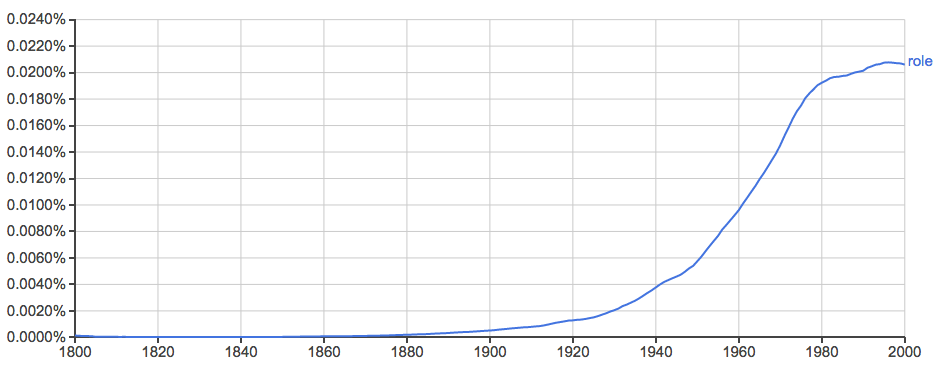
Nor was it common to think of people carrying out their duties as mere actors playing roles. This was described, before 1880, as “hypocrisy” — a word that meant behaving in a way not in accordance with your true feelings. Hypocrite comes from the Greek hypokrites ὑποκριτής, which simply means an actor in a play. From ancient times it was also used in such a derogatory fashion, in accordance with the traditional disdain for actors–a centuries-old prejudice which came to an end, perhaps not coincidentally, around 1900.
True, there was a character in a Shakespeare play who at one point mused, “All the world’s a stage, / And all the men and women merely players.” This character (Jaques, from As You Like It) was meant to be melancholy and forlorn, to a humorously exaggerated extent. Even in this sentence, his use of the world “merely” reflects how this statement offers a cynical and depraved view of humanity.
Rôle came to English through French, not in the works of any specific author, but as a slow trickle that eventually became a flood around the turn of the 20th century. Given that the French language also uses the word hypocrite, and presumably pre-20th century France had enough Greek speakers to know what it meant, how did the comparable word rôle come to take on a neutral connotation?
To answer this, I looked at an online dictionary of French, and discovered to my amusement that the earliest citation they have for the word rôle being used in a social or political sense is from the year 1789. To wit:
Mon rôle, à moi, est celui de tous les écrivains patriotes ; il consiste à présenter la vérité.
My rôle, to me, is that all of patriotic writers; it is to present the truth.
Abbé Sieyès, “What Is the Third Estate?” (1789)
Why does Abbé Sieyès use the word rôle here instead of devoir (duty)? There are two obvious reasons for this:
1. Abbé Sieyès was a faithless clergyman who got a job at the Second Estate simply to fatten his bank account and further his writing career. He was already playing a rôle, and was a hypocrite in every sense of the word. It would not be too hard for him to see radical pamphleteering as just another rôle to play.
2. During the Revolution, perhaps, people recognized that they were not executing any duties. Even if they disingenuously claimed to be “presenting the truth,” in fact they were only actors playing rôles in enabling the disintegration of the monarchy.
In conclusion, I urge you to stop translating gizen and gizensha as “hypocrisy” and “hypocrite,” and instead to find more appropriate words that bring the point of the Japanese home. Also, I urge you to help fix the English language by referring to people who do good deeds for ignoble reasons as “hypocrites.” Minds will be blown.
Posted: February 14th, 2015 | Rectification of Names
I wrote this post originally as the result of a Facebook discussion. I’ve revised it, adding some material on Russia, for this blog post.
Regarding the attack today on the French magazine Charlie Hebdo, there seems to be a misconception floating around that the magazine was “anti-Islam”. In fact it was anti-religion, anti-censorship, and anti-authority generally. Many of its past covers have depicted beloved religious, political, and cultural figures saying or doing obscene things, and would be considered far outside the rules of dignified discourse by basically any American media. I was pleased to see Rachel Maddow outline this simple fact on her show this evening.
I was recently at an Airbnb in Belgium, and one of their coffee table books was a lengthy comic book about penis-shaped fish being force fed to starving Africans by fat capitalists. There is no way such a comic could ever see print in America or Japan, but in France and Belgium it is par for the course in adult cartooning (my parents also own some French cartoons like this). Such absurdly obscene cartoons are not meant to inspire anger or to convert people to the cartoonist’s preferred ideology; they are meant to tear down the walls of your ego, and the things that you believe make you a good person because you hold them sacred, and thereby drag you down to the level of laughing alongside the cartoonist. This is one meaning of Meister Eckhart’s enigmatic saying, “He who blasphemes praises God.”
This intentional and meaningful testing of the limits of freedom of speech is one of France’s great accomplishments, in my opinion. Compare to Russia, where the overwhelming cultural consensus is that nobody benefits from obscenity and blasphemy, and blaspheming the Prophet Mohammed or the Orthodox Church is actually illegal; Pussy Riot intentionally broke this law and were prosecuted for it. Compare to America, where blasphemy is considered distasteful, but plenty of people do it anyway simply to be mean to people and prove how cultured and intelligent they are. The tradition of French cartooning does not try to be particularly clever or prove a political point: it merely looks upon all of the world’s attempts to establish order and narrative with the knowing grin of a Dionysus.
How did things turn out this way in France? Voltaire, Diderot, and the Encyclopédie were a start, but in fact there is much more to the story. For example, during the reign of Louis XVI, peddlers of pornography would gather in a square inside the court where due to an archaic law they were free from all censorship, and sell slanderous erotica about Marie Antoinette. Parisians at this time were naive, and believed the slander being published in these books—which is one of the reasons Marie Antoinette became so hated, and why the constitutional monarchy of 1789 dissolved into violence. The maturity needed for all of society to accept obscene fictions as part of the national character is hard-won, and the result of centuries of battle. An attack on this culture is an attack on France itself.
The Danish paper Jyllandsposten commissioned cartoons of Muhammad with the conscious intention of making Muslims angry, and put them all on a single page to prove that they could. This proves only that while Danes may think themselves more courageous than Americans and Germans, in fact they are insensitive and have no sense of humor. None of their “cartoons” were funny anyway. When Charlie Hebdo “republished” the cartoons they were actually importing them into a totally different cultural context. There is no such thing as “reprinting” a Danish idea in Paris: it immediately becomes a French idea. Charlie Hebdo’s idea was not “Muslims are barbarians,” but instead “Muslims are Europeans and French, and we can prove to them how welcome they are by making fun of their sacred cows.”
As one of the guests on the Rachel Maddow show pointed out, France is the most feared nation for Islamic extremists precisely because of their cultural sway; they demand that sacred cows be allowed to burn, and high and mighty egos set aside, for the shared goals of freedom, equality, and brotherhood. This is a clear and immediate danger to ignorant, barbaric, ego-driven terrorism, and the centerpiece of this culture is Charlie Hebdo. This is why all of France says “Je suis Charlie” tonight.
Posted: January 8th, 2015 | Kultur
Over on the Archdruid Report a busy-sounding person asked John Michael Greer to just send him a list of predictions, presumably so the commentator could check them off as the years go by. I suppose you could do this, but it misses the point of describing a historical trend; the narrative is essentially poetic, and you can either grasp some deeper layers of the poetry or you can’t; furthermore the layers you see might be invisible to the author. I think such a list would be of no value at all for Greer, since most of his historical writing took place in the past five years and most of what he talks about has yet to come, but we can get some value from writing up a list of the predictions made by his predecessor, Oswald Spengler. We now have about a century of difference between Spengler and us and can judge the accuracy of many of his statements.
So, I have attempted a 100th anniversary update to Spengler, maybe not quite in the same vein that caused people to write 20th and 30th anniversary updates to The Limits to Growth (“We’re still telling you so, and in 30 more years we’ll say we told you so”), but at least in the same great Western conceit that theories should make testable predictions. It became obvious while attempting this task that Spengler’s claims could not be written in checkbox form, and that if I quoted the entire supporting argument found in the text, this post would be book-length in short order. I have therefore paraphrased Spengler. Let us hope that it does not have to happen again.
Read the rest of this entry »
Posted: October 23rd, 2014 | History
Some interesting excerpts from Yasaka Takagi, ed., The Late Dr. Inazo Nitobe’s Unfinished Translation of Lao-Tzu and the Kojiki (Tokyo: Institute for Comparative Studies of Culture, 1963). The Lao-Tzu translation is not very remarkable except for a surprising cross-reference between ch. 28’s comments on “masculinity and femininity” and chs. 21 and 22 of a book called The Secret of Swedenborg by one Henry James.
As for the Kojiki text, it was written circa 1925-6 while Dr. Nitobe was a diplomat at the League of Nations, and is therefore the second English translation of the Kojiki, after the Orientalist effort of Mr. Chamberlain. I believe it is also the third translation ever, after the estimable work of Karl Florenz in 1919. It consists mostly of brisk summaries in sometimes oblique, sometimes welcoming English.
pp. 121-2
A summary of Japanese theories, showing the extent to which the Kojiki was considered a grounds for historical research in the prewar period:
Is this place [Takamanohara –AHM] wholly mythological so that there is no locality on earth to correspond to it? — If, on the contrary, it is a geographical location, where is it? Many conjectures have been advanced as an answer. (1) Somewhere in Central Asia, perhaps at the foot of the Altaian range, whence our race, at least philologically, seems to have come. (2) South Sea Islands. (3) Korea. (4) Japan itself,–in this case, in the South according to one theory; in the middle says another. (5) Armenia. (6) Hittite Kingdom. (7) Are we descended from Sumerians?
p. 127
As above:
The probable date of Susano-wo is given by Prof. Kume as 180-156 B.C.
pp. 135-6
A representative example of the style of writing:
Illuminatrice despatches Great Ears (Osiho-mimi) [Amano-Oshihomi] to the Plain of Abundant Reeds; but seeing that the land is in trouble, he returns to heaven and High Conjoiner and Illuminatrice convoke to a meeting eight hundred myriad Kamis for deliberation and with their counsel and the advice of Thinker, they decide to send down Hohi, a son born of Illuminatrice by Rashling; but he, on coming to the Plain, fawns to Land-Lord and stays with him for three years. For the third time, High Conjoiner and Illuminatrice confer with kamis, and send Young Prince (Wakahiko); but on coming to the Plain, he weds Land-Lord’s daughter and stops for eight years. A general assembly is held again and it is decided that this time a nameless female pheasant should be despatched. The bird alights on a tree near Young Prince’s gate, and delivers the message to him, but a spying woman insists upon Young Prince to shoot the pheasant through in the bosom.
p. 149
A note to the reign of emperor Sujin:
The erection of numerous shrines throughout the country means perhaps not that they were newly built where nothing had existed before, but that the “earthly” (native or local) objects of worship were acknowledged or adopted by the reigning house. One may consider it as an absorption of a native religion by the ruling family or a religious assimilation of the conquering and the conquered races.
p. 154
A nice turn in translation:
The Emperor having heard of the beauty of certain two sisters in Mino, despatched Oh-wusu, one of his elder sons to summon them to the court; but Oh-wusu, on reaching their home, took them for himself and sent two other women under the name of the sisters. When they arrived, the Emperor knew they were not the right ones, never married them but only subjected them to long glances so that they felt exceedingly embarrassed.
Posted: August 27th, 2014 | Excerpts
If you go to Amazon looking for the Chinese classics you will find a total mess. A bunch of publishers have ripped public domain books from Google Books and are selling them at various prices.
Why should you avoid these? (1) The original editions of what you are buying were bilingual, but the cheap books might have removed the Chinese. If you are really going to read these texts seriously you need the accompanying Chinese. (2) Even worse, these editions might be bad OCRs replete with typos and missing pages. (3) You will want to hang on to these print editions for many years, and the cheap publishers will likely give you a version with an ugly cover, and no guarantees on the quality of binding glue. (4) Any markup you are charged on the printing costs is done out of utter greed and adds no value to the book at all.
Here is the solution: buy print-on-demand versions from Google Books, thanks to the Espresso Book Machine. However, it is hard to find what you are looking for on Google Books’ search engine. So, I made this blog post.
The classics, by James Legge
This might sound kind of strange but some of the authoritative translations of the Chinese classics were made in the 1850s. I know, who was even reading them back then? The fact of the matter remains that James Legge still towers above any classical Chinese translator who has lived since, with the exception of maybe Burton Watson. There is still no other full translation of the Rites, Odes, or Documents. Furthermore, Legge’s books include the full Chinese in beautiful woodblocks, something that will probably never happen again.
Legge’s books can all be found on Google Books for free. The Espresso machine in the Harvard Book Store is the cheapest and shipping is also very cheap. I have included links for that order form as well, although you could just click the “Get this book in print” link available on the Google page. I also include a link to the Dover editions. These are rather good reprintings made in the 1970s that carefully mimeographed the original texts instead of swiping them under a digital camera. But they apparently did not find it profitable to reprint the more obscure books.
I have linked as well to any superior modern translations that are available so you can compare their merits with the Legge. The exception is the Mencius, for which there are other translations out there but I did not find any of them comparable.
* The Taoist texts were translated a little differently. They were in Max Müller’s Sacred Books of the East series and he apparently didn’t like including original texts. So, no Chinese, the Zhuangzi begins in the Tao Te Ching volume, and the translation is not the best. Might be better to consider alternatives.
What Legge didn’t translate
Legge translated the complete Confucian canon of the medieval era. However, Confucianism is more than just the canonical texts. Actually, Legge employed a scholar named Zhu Xi who was responsible for a major innovation in the way the texts were read. In order to really understand Confucianism it is necessary both to read texts that are outside the canon, and to read Zhu Xi and his detractors. Accessible translations of the unorthodox and medieval books are still in the works as we speak. Here is a list of what’s currently available for general audience readers.
Ancient books
Surprisingly, the Hanshu 漢書 has never been translated in full.
Zhu Xi
Unorthodox schools
Bonus: 19th century translations of Chinese literature!
Posted: July 21st, 2014 | Books, Confucius
I have to wonder when the Chinese government or classical scholars will set up a website for preserving all the premodern texts. There is Ctext but it is rather incomplete. In the meantime I have fetched a bunch of texts off the Internet and will be saving them here:
http://avery.morrow.name/j/
It already contains the complete works of 王陽明, etc. Let me know if there’s something else I should add.
Posted: July 4th, 2014 | Confucius
When I was in Japan I discovered, in a Japanese book, a very interesting list of Western writers. I hadn’t known about Chesterton in particular and I was delighted to read his work for the first time. Here are those writers, recommended in Nishibe Susumu’s Heroes of Thought (思想の英雄たち):
Edmond Burke, Søren Kierkegaard, Alexis de Tocqueville, Friedrich Nietzsche, Jacob Burckhardt, Gustave Le Bon, G.K. Chesterton, Oswald Spengler, Johan Huizinga, José Ortega y Gasset, Karl Jaspers, T.S. Eliot, Ludwig Wittgenstein, Friedrich Hayek, Michael Oakeshott
Now I recently found another interesting list. Here are the books recommended by Shōichi Watanabe’s Reading World History Through Classic Texts (名著で読む世界史)
History of Herodotus (HTML, Gutenberg, Kindle)
History of Thucydides (Gutenberg, Kindle)
Caesar, De Bello Gallico (HTML, Kindle)
Tacitus, “Germania”
Nanami Shiono, “The Story of the Roman People”
Christopher Dawson, “The Making of Europe”
Machiavelli, “The Prince”
Carl von Clausewitz, “On War”
Shōichi Watanabe, “The German General Staff” [Yes, Watanabe describes his own book as a classic…]
Oswald Spengler, “Twilight in the West”
Cecil Chesterton, A History of the United States (JPG, Gutenberg, Kindle)
Baron Macaulay, “The History of England from the Accession of James II”
Hilaire Belloc, The Jews (JPG, Kindle, used)
edit: I downloaded Macaulay’s book and I am enjoying it quite a lot. I edited this post to provide more reading options for people.
Posted: May 16th, 2014 | Books
I had a little bit of free time after church on Sunday and decided to see if there was any interesting resource extraction news I had missed in the past few months. Here is what I found.
A January 2014 article in the journal Energy reexamined a group of 10-year oil production scenarios proposed in 2004. A comparison of the scenarios to available figures shows that global conventional oil production peaked in 2005, with additional peaks from 2008-2011 for broader definitions of “conventional oil”. The article is available open access for anyone to examine the math, but it looks rather solid to me. Cheap oil is already in decline. So, why does oil production appear to be stable, or even increase? This is due to artificially increased production from a short-term burst of capital expenditures, as well as the explosion in shale gas, tight oil, and easily transportable liquified natural gas, which are usually improperly labeled as conventional oil in media and industry reports. The optimistic (industry) view is that these new sources, combined with decreased demand in the post-industrial West, will be able to keep things humming for some decades while more renewable options (or nuclear developments) are worked out. On the pessimistic side, John Michael Greer considers these options to simply be delaying the inevitable for a decade at most. In any case, there can no longer be any doubt that we are in the peak oil era.
On April 10, the Club of Rome released a book on peak mining, Extracted: How the Quest for Mineral Wealth Is Plundering the Planet. I have not read it yet, but based on what I have heard about peak mining so far, I expect that it will reveal a hidden crisis. The geopolitical consequences should be fairly obvious. In a peak oil world, oil exporters have political leverage, which is why Saudi Arabia was treated with kid gloves after 9/11 and the sanctions against Russia’s Crimea actions were basically symbolic. Mining has even sharper consequences: if one country should control the world’s supply of a basic element, the only options for industrialized nations are to give in to political demands or suffer massive economic damage.
In March the WTO ruled that China has been imposing illegal tariffs on rare earths. China controls over 90% of the world’s rare earth reserves used for making cell phones etc., and by restricting its exports temporarily quadrupled the price of rare earths outside China in 2011, causing some manufacturers to relocate their major operations to China. The WTO ruling was appealed on April 18 and we have yet to see whether China will actually abide by it: the quote offered to reporters, “No matter what the result of the appeal is, China’s policy goal of protecting resources and the environment will not change,” is not encouraging. It is interesting that the international ruling “prohibiting” Japanese whaling, which resulted in a mere reduction of the year’s catch from 380 heads to 210 heads, was blanketed all over the airwaves despite its economic irrelevance, while the international ruling against China is met with popular disinterest, although I am sure Western governments are watching it closely. Whales are at least in theory a renewable resource; rare earths are not.
In financial news, last year we heard that the Dodd-Frank financial reform was a death knell for American small banks and had homogenized our financial system. In March of this year, the IMF reported that these changes were likely to become permanent because there is no real way to avoid them. This basically means that the Western financial system is extremely fragile and there is no way to tell what the impact of another economic bubble could be. It is interesting to note that China and Japan have adopted a radically different approach to their financial systems, but I cannot find a really reliable article about that at the moment.
Anyway, that’s all I got for now… I’ll continue to be on the lookout for reliable information about this.
[An earlier version of this post focused on “too big to fail” subsidies, but our knowledge of these subsidies’ impact is somewhat speculative.]
Posted: April 21st, 2014 | Signs of the Times
A religious studies blog I follow, Religious Studies Project, has a rather telling April Fool’s joke today. Since they might delete it after April 1, I will take the liberty of quoting the whole post here.
BREAKING NEWS: Today, the RSP is “born again” – as the Theological Dispatch.
Due to a huge donation from the Templeton Foundation, we are now going in a slightly different direction. As of today, our mandate is to investigate how religion and spirituality brings positive change to society, and helps make us all better citizens of God’s world. We shall not rest until the Christian and the Muslim can go on a date together in a Chinese restaurant without fear of criticism.
It’s time to admit that spirituality is REAL. We hereby disown our previous cowardly epistemological agnosticism and cynical critical thinking. From here on in, our only theory is Truth, and our only method is Faith. God will be remembered long after Fitzgerald and McCutcheon are forgotten.
Donald Wiebe got it right, there is no future for the religious studies. But there is advertising revenue for theology.
Since this is a joke, the bloggers (mostly Ph.D. candidates, I believe) must think that the idea that “spirituality is REAL” is amusing in some way. That might sound like a harsh generalization, but this was the general attitude of my undergraduate classmates, who openly mocked religious groups at parties etc., and I am aware that this was also the fashion at several other undergraduate religious studies programs. Considering that someone who chooses to do a doctorate program in religious studies must be somehow attracted to the state of the academy, I think it is probably fair to say that the Ph.D. candidates writing for this blog find spirituality amusing.
Here is another joke: “As of today, our mandate is to investigate how religion … helps make us all better citizens of God’s world.” I would deeply respect someone who offered this as a mission statement for a book, even an academic publication. After all, the idea that the world does not belong to us alone, that it is “God’s world”, is something it is hard to be neutral on. A past generation of religious scholars, including Huston Smith, often embraced something like this sentiment. The current generation, though, is generally critical of this, and of any sentiment towards the world. The only truly scholarly attitude, they have learned, is an alienated one.
For example, Mama Lola, a sympathetic account of a scholar’s acceptance by a voodoo community that verges on a statement of personal belief, was published in 1991. Could a similar book be published today? An example of an academic publication recently reviewed at Religious Studies Project is Big Gods: How Religion Transformed Cooperation and Conflict, which consists of a list of assertions like “people are nicer when they are being watched” and “as groups increase in size and social complexity, belief in ‘Big Gods’ or moralizing Gods increases”. It is a mystery to me how the author of this book would engage with Porphyry, Jayadeva, or Zhuangzi. But I do not think there is any attempt at understanding here, only the self-assured superiority to all human feeling that comes with “scientific” knowledge. The spirit of Mama Lola has been totally purged from the academy, which is why the Templeton Foundation gets the scholars’ scorn.
Finally, the post gets in a good-natured dig at Timothy Fitzgerald and Russell T. McCutcheon, two scholars who question the validity of the scholarly concept of “world religions”. It is true that both Fitzgerald and McCutcheon are atheists, which prompts the joke “God will be remembered long after Fitzgerald and McCutcheon are forgotten,” an… uh… imitation of Christians’ attitudes towards Nietzsche, Darwin, etc. But it seems like the author of the post does not really understand the practical meaning of constructionism. By putting into question the tools that scholars use to compare cultures, Fitzgerald and McCutcheon actually doubt the methodological superiority of scholars to believers, which is why McCutcheon calls for an open confession of atheism on the part of scholars. In fact, the great Catholic writer G.K. Chesterton made the basic constructivist argument long before Wilfred Cantwell Smith, when he expressed his skepticism of the comparative methodology employed by H.G. Wells:
[Religious studies] seeks to classify Jesus … by inventing a new class for the purpose and filling up the rest of it with stop-gaps and second-rate copies. I do not mean that these other things are not often great things in their own real character and class. Confucianism and Buddhism are great things, but it is not true to call them Churches; just as the French and English are great people, but it is nonsense to call them nomads. There are some points of resemblance between Christendom and its imitation in Islam; for that matter there are some points of resemblance between Jews and Gypsies. But after that the lists are made up of anything that comes to hand; of anything that can be put in the same catalogue without being in the same category.
G.K. Chesterton, The Everlasting Man (1925)
The post concludes with a joke that sounds slightly somber: “Donald Wiebe got it right, there is no future for the religious studies.” As my grandma likes to say, “with every joke, there’s a meaning.”
Posted: April 1st, 2014 | Secular-Religious
邦訳は以下である。
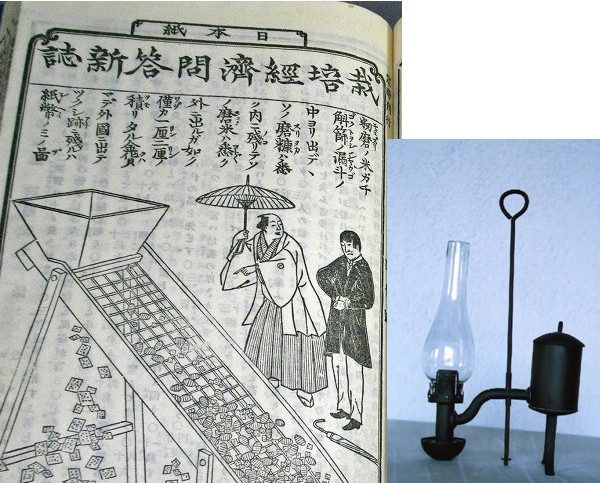
You may be familiar with Jun’ichirō Tanizaki’s essay In Praise of Shadows (1933). But were you aware that Tanizaki had a predecessor in the form of a Meiji period crank? I think not! Kaiseki Sata was a Shin Buddhist monk who published a ferocious series of essays in the 1870s, on topics such as “On the Uselessness of Bookkeeping and Ink”, “On Boycotting the Solar Calendar”, “On the Four Dangers of Western-Style Umbrellas”, “On the Great Dangers of Milk”, “On Railways: The Ruin of the Nation”, and everyone’s favorite, “A Caution Against Lamps: The Ruin of the Nation” (1880).
I was unable to find any information about the majority of these essays, but the logic of “Lamps: The Ruin of the Nation” is actually not bad. Sata warns his readers that to light Western-style lamps you need kerosene, but Japan’s only oil fields are in Niigata, and would be depleted within 50 years (1930). If Japan becomes addicted to lamps and exhausts the Niigata fields, they will have to trade their reserve funds for oil until they have no more funds, and the nation will be ruined quod erat demonstratum. The argument is basically that oil is a non-renewable resource, and is therefore not backwards but remarkably foresighted.
“The West became civilized in the Western way,” said Kata, “and Japan will become civilized the Japanese way.” He had no desire to plunge Japan into darkness. Instead, he invented himself a lamp that ran on vegetable oil, to which he gave the suitably native name kankōtō (pictured above; source). He also advocated for Japanese lamps, andon, which ran on fish oil.
Sata only neglected to recognize that Japan could not defend its independence from the oil-powered Western nations without finding some oil of its own. Running steamships and tanks on vegetable oil would have been quite sustainable, but not politically viable. Indeed, the military use of oil was a principal motivation behind imperialism and World War II.
Again, none of the other essays are available online, so I don’t know what the dangers of Western-style umbrellas were, but at least some of them are apparently collected in a journal he ran (also pictured above). Or you can read “Bread: The Ruin of the Nation”, by an unrelated author, at the National Diet Library site. Learn why bread will cause Japan’s physical, spiritual, and economic ruin! If only we had listened…
(Japanese translation)
谷崎潤一郎の「陰翳礼讃」はご存知かもしれないけど、陰翳が好きだった先人はもちろん明治にもいた。それは佐田介石という真宗の坊主で、明治初期に激しい文明開化批難の投稿を次々に発表した。「簿記インキ無用論」「牛乳大害論」「蝙蝠傘四害論」「太陽暦排斥論」「鉄道亡国論」そして佐田の声望を高からしめた「ランプ亡国の戒め」である。
これらの記事の殆どは今では手に入らないが、唯一手に入る「ランプ亡国の戒め」を読むと、非常に論理的である。当時、日本の油田は越後にしか存在しなかったため、50年後(西暦1930年)に国産石油がなくなって、ランプの石油に補助金を出さないといけないようになるから、亡国になるという戒めである。石油は枯渇性資源というわけで、実は時代遅れの亡国論じゃなくて、驚くべき先見の明である。
「西洋には西洋の文明開化あり、我が日本には日本の文明開化あり」と語った佐田にとっては、日本を真っ暗にするわけにはいかなかった。代わりに、菜種油を使う「観光灯」を発明した(写真上)。国産の魚油を使う行灯も支持した。
そんな佐田だったが、かれが唯一が予言できなかったのは、大量の石油を持つ西洋に対して日本の独立を守るため石油の発見が日本にとっては必須だったことである。菜種油エンジンの戦艦か戦車はエコな夢だけど、政治的に実現が不可能である。満州事変や太平洋戦争の原点はこれである。
繰り返しになるが佐田の他の投稿はネットに載っていないから、蝙蝠傘の四害は分からないが、一部の投稿が「栽培経済問答新誌」という雑誌に集められたようである。或は、佐田とは全く無関係の作家によるものではあるが、同じく明治期の文明開化批難の言論として、「食パン亡国論」を国会図書デジタルライブラリーで読むことができる。これには、「肉体、精神、経済」上の亡国が書いてあって、ご飯が完全な主食だった過去の時代を懐かしがっている…
Posted: February 28th, 2014 | Japan, Signs of the Times